
How to Sell a SaaS Business When You're Around $1K MRR
Yes, a $1K MRR SaaS can be sellable. Learn what buyers inspect, what kills deals, and how to prepare a clean micro-SaaS exit without a noisy process.
Direct Answer
Yes, a SaaS business around $1,000 MRR can be sold, but the buyer has to believe the handoff will not turn into a second job. At this size, risk matters more than elegance. A $1,000 MRR SaaS with low churn, clear billing, a simple codebase, and two support tickets a month is a different asset than a $1,000 MRR SaaS that needs 15 support hours per week and only works because the founder knows every workaround.
The sale is usually less about running a dramatic process and more about proving the basics: real recurring revenue, stable customers, manageable support, transferable code and accounts, and a founder who can explain the business clearly.
Who This Is For
Can a $1K MRR SaaS Really Be Sold?
A tiny SaaS can be sellable. The catch is that it has to be simple enough for a buyer to understand and operate. A buyer is not only buying the current revenue. They are buying the right to maintain the product, keep customers happy, and decide whether there is enough upside to justify the effort.
At $1K MRR, the buyer is usually thinking in practical terms:
- Can I verify the revenue?
- Will customers stay after the founder leaves?
- Can I understand and run the code?
- How many support issues will land on my desk?
- Is the founder honest about the problems?
If those answers are mostly clean, a sale conversation can make sense. If the answers are vague, the business may still be useful to you, but harder for a buyer to underwrite.
What Buyers Care About at This Size
The buyer's lens is simple: what can go wrong after close, and how quickly would I notice? A buyer of a $1K MRR SaaS is not expecting a perfect company. They are looking for risks they can price, fix, or accept.
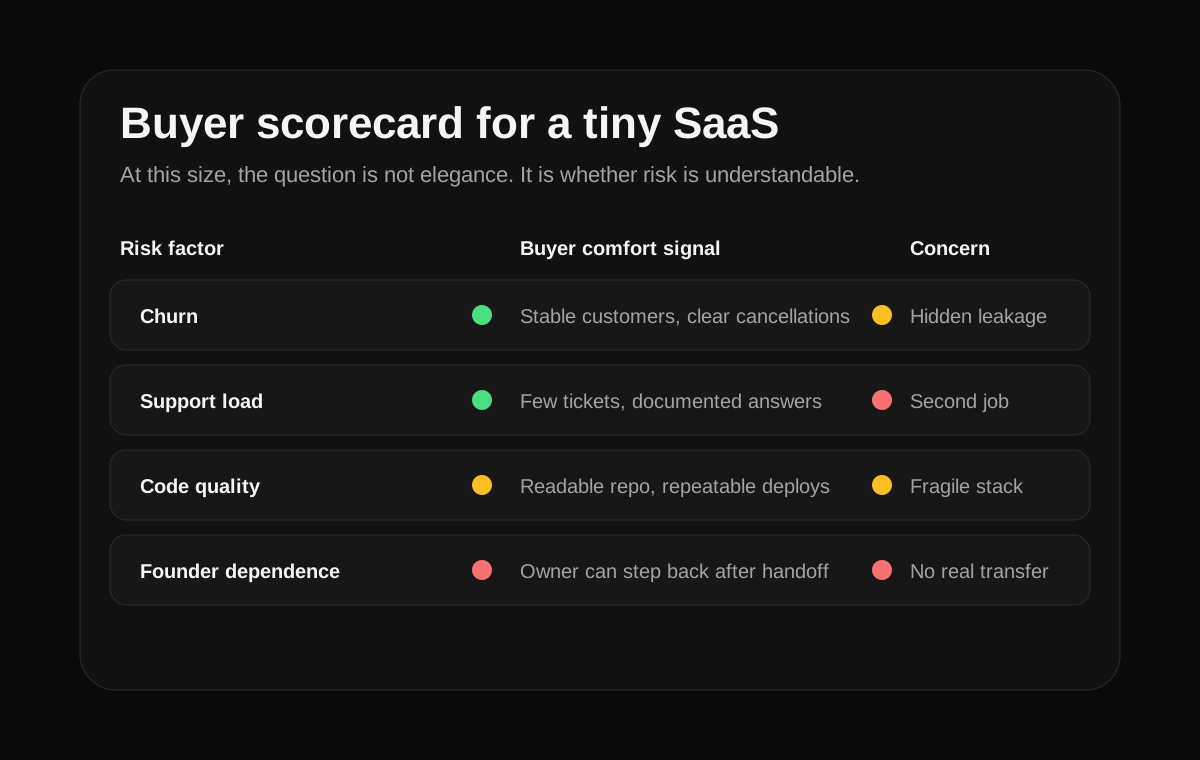
The strongest small SaaS sellers can explain the business in plain language: who pays, why they stay, what breaks, what support looks like, and what would make the product better.
If you want to understand the valuation side of that buyer thinking, read small SaaS valuation multiples explained.
What Makes a Small SaaS Attractive
Small buyers like clarity. They will forgive an old UI before they forgive unclear revenue or a product that only the founder can operate.
| Area | Attractive | Risky |
|---|---|---|
| Revenue | Recurring payments are visible in Stripe or a similar billing system. | Revenue is mixed with one-off work or hard to reconcile. |
| Customers | No single customer can break the business alone. | One or two customers make up most of MRR. |
| Support | Support is light and repeatable. | The founder spends nights handling edge cases. |
| Product | The product solves a narrow, real workflow. | Customers need constant custom work to get value. |
| Handoff | Deploys, accounts, and core workflows are documented. | Only the founder knows how to keep it running. |
Hypothetical example: a $900 MRR scheduling add-on with 30 customers, low ticket volume, and a boring codebase may be easier to buy than a $1,400 MRR product with a single $800 customer and fragile scripts that fail every month.
What Makes Buyers Walk Away
What can kill the deal is usually not one small flaw. It is the buyer realizing the business is less transferable than it looked.
Common deal killers include:
- Revenue that cannot be tied to customers.
- Churn that is hidden by new signups.
- A codebase that cannot be deployed without the founder.
- Customer promises that are not written down.
- Support that is much heavier than described.
- Key assets held in personal accounts that cannot be transferred cleanly.
- The founder becoming defensive when asked basic diligence questions.
None of those automatically means your SaaS has no value. They do mean you should fix what you can before expecting a serious buyer to move quickly.
What to Prepare Before Talking to Buyers
Preparation does not need to become a full-time project. A small SaaS seller should have enough proof to let a buyer decide whether the next conversation is worth having.
| Item | Why it matters | Good enough version |
|---|---|---|
| MRR summary | Shows the buyer what is actually recurring. | Monthly MRR by customer or plan for the last 12 months. |
| Profit estimate | Tiny SaaS buyers care about real cash flow. | Revenue minus hosting, tools, payment fees, contractors, and support costs. |
| Customer list | Reveals concentration and retention. | Customer name or anonymized ID, start date, plan, current MRR. |
| Support summary | Shows whether the product becomes a job. | Ticket count, common issues, and hours per week. |
| Technical notes | Makes handoff risk visible. | Repo location, framework, hosting, deploy steps, cron jobs, key integrations. |
| Transfer list | Prevents late surprises. | Domains, app accounts, payment accounts, email, analytics, docs, credentials plan. |
For a deeper version of this list, use the SaaS due diligence checklist for sellers.
How the Sale Process Usually Works
The cleanest small SaaS process is short and direct. It usually looks like this:
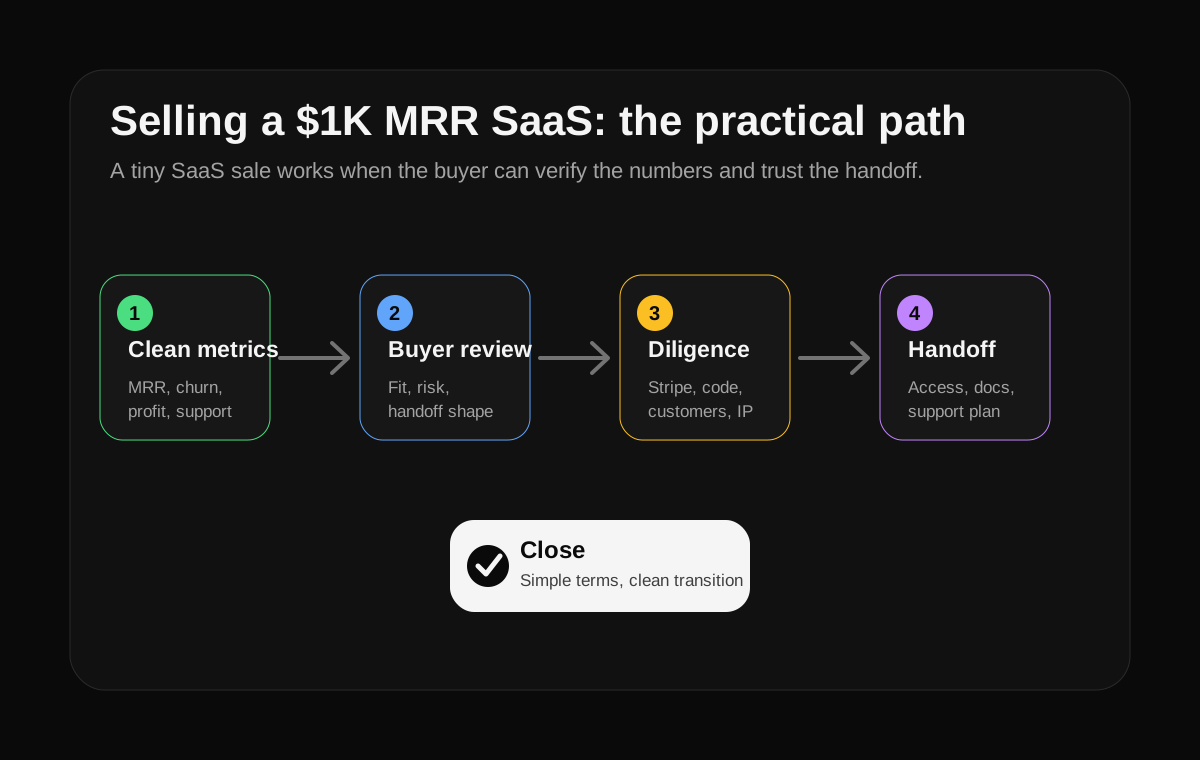
- You share the basic numbers and your reason for considering a sale.
- The buyer reviews fit, revenue quality, support, and technical handoff.
- If there is alignment, the buyer asks for diligence materials.
- Both sides agree on structure, transition, and what is included.
- The founder transfers assets and helps with a defined handoff.
If you are comparing channels, the guide on where to sell your SaaS business explains marketplace, broker, direct buyer, and strategic acquirer routes.
How to Make Your SaaS Easier to Acquire
The best pre-sale work reduces uncertainty. Do not spend three months rebuilding the product unless the current product is genuinely blocking customers. Small buyers usually prefer proof and simplicity over a cosmetic rewrite.
Good cleanup work:
- Write a one-page operator note: how the product works, where it breaks, and what to watch.
- Reconcile billing to customers.
- Remove unused paid tools.
- Document deployment and rollback.
- Create a short list of the top customer support questions.
- Separate business assets from personal accounts where possible.
Bad cleanup work:
- Rewriting the app to impress a buyer.
- Hiding churn or support burden.
- Launching a new growth channel right before selling and calling it traction.
- Creating projections that are not grounded in recent behavior.
- Best fit: SaaS doing roughly $500 to $5,000 MRR.
- Useful even if you are only curious about options.
- No customer contact or disclosure without permission.
What to Do Next
If you are unsure whether to sell or keep going, do this first:
- Write down current MRR, customer count, monthly profit, support hours, and churn.
- List every account or asset that would need to transfer.
- Identify the biggest reason a buyer might hesitate.
- Decide whether that issue can be fixed in a week, a month, or not worth fixing.
- Ask for a buyer's read before you spend months optimizing the wrong thing.
At this size, your job is not to create a perfect M&A package. Your job is to make the business understandable enough that a serious buyer can say yes, no, or not yet.
FAQ
Is $1K MRR too small to sell?
Not necessarily. It is too small for many institutional buyers, but not too small for every direct buyer. The key question is whether the revenue is real, durable, and transferable.
Should I improve the SaaS before selling?
Improve the parts that reduce buyer risk: metrics, support documentation, account transfer, deploy notes, and customer clarity. Avoid big product bets unless they are already needed for customers.
What if the code is ugly?
Ugly code is not always fatal. Undeployable code is a bigger problem. A buyer needs to know how to run, fix, and transfer the product.
Will buyers contact my customers?
They should not contact customers without permission. A buyer can often review anonymized customer and billing data first.
What if I am only curious?
That is fine. A quiet review can help you decide whether to hold, clean up, or sell without starting a public process.